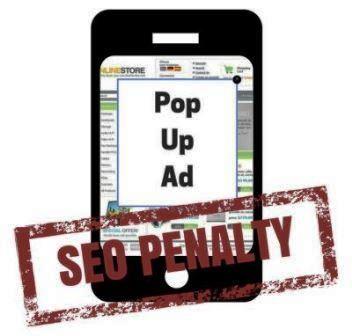
Prepare For The Upcoming Popup Penalty

mobile popup penalty

Google will be punishing ad pop-ups in three months!

In our last post, we alerted you to the fact that Google is going to be changing how they rank websites that are using intrusive pop-ups and interstitials as of January 10th, 2017.

And where you rank with Google could have a big effect on your business, since we all know that very few people search beyond page 2 or three of Google rankings.

There are benefits of this upcoming punishment. The biggest benefit is that visitors will have easier access to content without dodging forced pop-ups and interstitials distracting and annoying them. As well, there will be no forced subscriptions or accidentally clicking on call to action buttons.

But there’s also a bit of a dilemma. If you show an ad via pop-up or interstitial on a mobile device, odds are your Google ranking will suffer. But if you don’t show an ad, how is your offer going to be found and how will your email subscriber list grow?

Like everything, there is a solution to every problem. Google has green-lighted some popups which will not be considered punishable and, as a result, will not affect your search ranking.

Google Webmaster tools says that interstitials appearing as a result to a legal obligation (such as for cookie usage or age verification) will not trigger a penalty. Additionally, login dialogs on sites where content is not publicly indexable, such as emails or an indexable content behind a pay wall, is also safe. And banners using a reasonable amount of screen space that are easily dismissible will also not be punished.

Also of note, this penalty is applied on a page by page basis, which means that while the page will be demoted in Google search, the entire site will not suffer.  Unless, of course, you are running popups on your entire site. If so, you could see a global drop in SERPs, as each could take a small hit.

There are legitimate solutions that will keep your rankings safe while still popping up to offer your products and services and/or to grow your list.

Consider the following alternatives, converting intrusive pop-ups to friendly pop-ups.

1. Hide pop-ups on mobile devices. By using display targeting rules in your pop-up program, you can hide pop-ups and interstitials from mobile devices, showing them only on desktops, avoiding Google’s penalty

2. Change your delivery method. Instead of using pop-ups and interstitial on mobile, use smaller messages such as banners, in lines, or slide ins. Actually, some of these alternatives actually show a better conversion rate as they are smaller and adjust to screen size.

There are lots of providers of pop-up programming available, some paid in some free. Do your research now, find a provider for your business, and be prepared for the changes in January.

Until next time…

Are you ready to grow your business now? If you’re ready to take the next step and make your business more profitable, contact us today.

If you like the information you are receiving, please consider forwarding this post.

Popup Punishment Around The Corner

popup penalty

Are pop-ups your friend or your foe?

Well, that depends on whether you are using pop-ups for your website or online business, or if you’re an Internet surfer or website visitor.

Let’s face it, pop-ups can be annoying! All of us – even those who use pop-ups on their own sites – become impatient and annoyed with intrusive pop-ups. But pop-ups exist for one reason: they work!

Some statistics show that marketers have received a 1350% increase in subscription rates, as well as a conversion rate of 10 times by using pop-ups. And with mobile use increasing every year, many marketers have targeted their email subscription pop-ups to mobile devices as well as desktops, boosting their conversions to more than 1700%.

But all this is going to change as of January 10, 2017.

This is the date that Google has announced that it will begin penalizing mobile pages that are showing intrusive pop-up and interstitial ads, affecting their search results.

This is going to have a huge impact for many marketers as overlay pop-ups, full screen welcome mats and standalone interstitial have been huge conversion boosters for most people. But with Google still dominating the online search world, you had better be prepared for this change and begin looking for solutions.

There are three main reasons why Google started punishing sites using these for screen pop-ups and interstitials, keeping the user experience of mobile browsing in mind.

1. The main content is being blocked. Screen space on mobile devices is much smaller than on desktops, resulting in the main content of sites becoming obstructed with the display of pop-ups, overlays and interstitials.

2. Lousy user experience. Intrusive interstitials on pages results in a poorer user experience as compared to pages where content is immediately accessible. If your interstitials are spammy, difficult to dismiss, or diminish your users’ experience, your mobile page may be devalued.

3. Clicking ads accidentally. These pop-up ads tend to take up a huge amount of screen real estate while having the smallest possible buttons to close out and dismiss them, inevitably resulting in the user accidentally clicking on the ad.

So, what’s the penalty?

Google’s intention is to keep pace with the way users are accessing the Internet, and to ensure that users are finding the best answers to their questions as quickly as possible, regardless of the device. As a result, Google has decided to punish sites using these intrusive pop-ups on mobile devices, meaning if you continue to use these, your ranking may suffer if you are still using intrusive pop-ups for mobile users. Note that Google doesn’t penalize non-intrusive interstitials.

The three types of pop-ups and ads that are most likely to get you punished are:

1. An intrusive pop-up covering the main content, either immediately upon page load or while the visitor is looking through the page.

2. An intrusive interstitial that looks like a forced ad, requiring the user to dismiss before gaining access to the main content.

3. A full screen pop-up overlay, or standalone interstitial, requiring the user to dismiss before the main content is accessible.

There are pop-up solutions available that will help grow your lists and your conversions while coloring inside the new lines that Google has established. Use these guidelines and be prepared for next year. After all, as a user you will appreciate these changes.

Until next time…

Are you ready to grow your business now? If you’re ready to take the next step and make your business more profitable, contact us today.

If you like the information you are receiving, please consider forwarding this post.

How To Find Your Dream Marketer

professional marketer

When looking to grow your company, it makes sense to hire a marketing strategist.

Business owners don’t blink when it comes to hiring specialists for their business such as accountants, lawyers, and customer service reps.

Yet, for some reason, many entrepreneurs and business owners resist the move to hire a professional marketer. Many times they think it can be done in-house, often resulting in a haphazard approach and questionable results.

Keep in mind that your marketing team is what puts money directly into your pocket. Therefore, spending money in this area should be seen as an investment rather than simply an expense.

Hiring a marketing professional does come at a cost. Based on Robert Half’s salary guide for 2023, the median salary for a creative director is around $159,000 per year, depending on location. Adding benefits to this base adds an additional 25 to 40%, according to Joe Hadzima of the MIT Sloan School of Management. If you choose to hire a consultant rather than bringing on an employee, you will shave the benefit portion from these figures. But anyway you look at it, if you’re going to hire a quality marketer with any level of expertise, it will represent an investment.

Read more

Avoid Google Penalties

google penalties

Don’t get caught making these simple mistakes that could incur penalties and affect your traffic.

You don’t have to be a search engine optimization specialist to know that there have been some big changes in how Google ranks sites over the past few years.

Nearly anyone who has a website has heard of the Panda and Penguin updates Google made in the past few years.  And of course, Google continues to make changes to its algorithm to ensure it maintains its position as the top search engine. But be aware that these changes can affect how your site is seen by Google and you must do your best to stay on top of them so you don’t incur a penalty.

In the early days of search engine optimization, the “experts” would dump keywords heavily into content, often delivering something that might attract a higher ranking but certainly would not engage the reader. Another tactic was to build links with other sites that may have been low-quality links from directories and other spamming sites that few people ever really clicked on.

The changes that Google has made to their algorithms has actually resulted in better quality. These old tactics no longer work, thank goodness, and the trend has been toward content marketing. Providing people with content that is relevant and valuable to them has also proven to work well to assist with rankings.

But there are still some ways that you can inadvertently end up with penalties from Google while engaging in content marketing.

Avoid the following and your site is likely to stay safe.

1.  Lack of unique content: Another area where you can run into difficulty is by providing a lack of content that is unique. Duplicating other content in a copy and paste fashion is like playing Russian roulette and it is likely only a matter of time until your site is penalized. If you are an affiliate marketer, do your best to avoid the simple copy and paste method as well, as this will be seen as not providing value and may end up causing Google to penalize your site by lowering your ranking.  Do NOT plagerize!

2.  Over-optimizing or low quality internal content: What of the things that Google algorithms search for is the quality of your content within your website. Make sure you are providing unique, new content to your website on a regular basis and avoid rampant repetition of your content throughout your site. This not only will help you avoid incurring penalties, but also will significantly boost your organic rankings. Use different types of content as well, like podcasts, video as well as written blog posts. Google will notice and you should be rewarded.

3.  Keep current: I have often heard people say that they have finished their website. Now, I know what they mean by this, but keep in mind that your website is never finished. It should be seen as a living, breathing entity that requires some attention. Ensure that your website is kept current, removing content that is no longer valid, updating content, and making sure that all your links are working properly. If you don’t have current information on your site, not only will visitors not want to return but Google will also lose interest in your site.

The biggest penalty is to lose your ranking.  It is a difficult and never-ending job to stay on top of your optimization.  Don’t risk your reward by cutting a few corners.

Until next time…

Are you ready to grow your business now? If you’re ready to take the next step and make your business more profitable, contact us today.

If you like the information you are receiving, please consider forwarding this post.

Defining Your Marketing Strategy

marketing strategy

Before you can define your marketing strategy, you must understand exactly what a marketing strategy is.

Simply put, a marketing strategy is a plan structured around the resources available to you to promote and grow your business, targeted to your defined ideal client.

So now that you have this definition, review the following list to measure the current status of your marketing strategy and consider where it could go by integrating a structured marketing strategy in the future promotion of your business.

The top dozen questions to define your marketing strategy:

1. First of all, what is it about your business that you are passionate about? Reflect back on what motivated you to start your company.

2. What is it that you provide to your target market in ways that differ from your competitors?

3. Just like people, businesses have – or should have – a personality. What is the dominant trait in your business that you want your customers to identify?

4. What does your ideal client look like? This, really should have been identified when you were planning your business. After all, you can’t be everything to everyone, and if you haven’t defined your client by now, your business is probably flailing.

5. You’ve heard about the “elevator speech”. What is yours? Come up with a simple 10-word message that defines, explains and excites prospects about your business.

6. How does your target market become aware of your business? Within this question, you should be able to identify where and how you can best reach your target audience.

7. How do you build trust? People do business with those they like, no, and trust. What are you doing that will build trust to your target market, assuring them that you are the best person to do business with.

8. How is your cash flow? Be realistic. If you aren’t honest with yourself about your cash resources, you can’t be realistic about what you can achieve. If you are in a position that you have assets but require interim assistance was financing projects, what revenue sources are available to help you grow your business?

9. Put yourself in your customers’ shoes. By walking a mile in your clients’ shoes, you can define and refine the customer experience. Happy client not only becomes a repeat client, but also becomes a source for referrals by becoming an advocate for your business.

10. Once you have defined where you want to goal, what gaps in resources do you face? None of us are experts at everything. Define what you can do and either assign tasks to someone else in your organization in their area of expertise, or outsource to a professional.

11. Do you require partnerships with others in order to achieve your goals? In some cases, it makes sense to partner with complementary business professionals to keep costs down, share resources, and benefit.

12. Finally, now that you’ve answered all of these questions, what does the result of implementing this strategy look like? If you see any holes in the results, review the list again and refine your strategy further.

Until next time…

Are you ready to grow your business now? If you’re ready to take the next step and make your business more profitable, contact us today.

If you like the information you are receiving, please consider forwarding this post.

Allocating Your Search Budget

search budget

Does deciding how to allocate your search budget seem like a daunting task?

Should you use Google PPC or social PPC?

This question comes up often, especially amongst entrepreneurs and small business owners who are trying to manage their online marketing budgets themselves.

There is of course no right answer, and it’s hard to know right off the bat which of these avenues will provide the best return on your investment. Therefore, let’s take a look at a couple of determining factors to help make your decision.

First of all, like every other marketing initiative, you must identify your goals and the metrics you will use to measure the success or failure of your undertaking. What is the purpose of your online campaign? Are you looking for an awareness campaign that will generate clicks to your page? Is your focus on getting leads? Are you looking to advertise at the lowest possible cost per lead? Or maybe you’re simply looking to increase your following on various social media platforms.

Once you’ve identified and clarified your goals, see which platform is the best fit for your target audience. Based on what your product or service offering is, some social media channels make more sense than others. For example, LinkedIn is more of a business/professional network, as opposed to Facebook or Twitter which are more social in nature.

The next thing to do is to define your budget. Paid search has improved greatly over the years, and allows you to drill down to a finite definition of your target audience. And, in some cases, you can even designate what times of day your ad will appear. Remember that some of your keywords may be more competitive than others, and more competitive they are the more expensive they will be. Remember to set your daily spend a limit so that you do not blow your budget.

Once you got this figured out, my best advice is to run a small test campaign. Allocate a small portion of your budget to each of the areas that you have determined are a good fit for your target audience and run the test campaign for three days to a week. Check your metrics on each platform to determine which is working the best for you. Once you have learned what is working, focus your efforts on that area.

Remember that there may be a benefit to advertising on a specific platform even if it’s not the most inexpensive choice. Organic search rankings can be augmented by paid search ads, regardless of whether it is on social media platforms or on search engines. Weigh the pros and cons; only you know if the cost of running a small paid campaign will help you attain your goals.

Until next time…

Are you ready to grow your business now? If you’re ready to take the next step and make your business more profitable, contact us today.

If you like the information you are receiving, please consider forwarding this post.

How To Evaluate Email Campaigns

email campaign

Are you still measuring your success by open and click through rates and the size of your email subscriber list?

Yes, these metrics do still matter.

But measurement and evaluation of email campaigns has become much more sophisticated as email marketing has become more sophisticated.

Once upon a time, it was cause for celebration and doing the happy dance if your measurement tools showed that most of your emails were being opened and clicked through, and that your subscriber base was growing. As the saying goes in e-commerce, the money is in the list. This will never change. After all, sales is a numbers game and the more people who see your offerings, the more sales you will get.

But times have changed. More and more business happens online, and this avenue only continues to grow. Therefore, it is important to ensure that your email campaigns are following a specific strategy. And it just like any other marketing strategy, be sure that you are starting by defining the goals of your email campaign.

When determining your goal, use the following blueprint to help define it:

1. Be specific. If your message is unclear, you risk confusing your audience. In a confused recipient is unlikely to become a buyer.

2. Make sure your campaign is measurable. Regardless of what type of marketing campaign you are running, if you can’t measure your results you are simply wasting your time and your money. Make sure that you are using qualitative and quantitative goals within your measurement format.

3. Make your goal achievable. You have to do this for a number of reasons, but most importantly if you set goals that are outside of your scope, you risk running out of resources or facing dramatic disappointment, potentially tainting your outlook for future campaigns.

4. Set a time for your campaign to run. Deadlines are important. If you do not set a deadline, you are missing one of the most critical elements for measuring the success of your campaign.

5. Make sure that your campaign is relevant. Yes, it’s important to communicate with your subscribers on a regular basis and to ensure that you are providing them with opportunities. But if these offers and opportunities are not relevant to your audience, they will lose interest and unsubscribe.

Now that you have structured the blueprint for your email campaign, be sure that you are clear on your goals. Back to measuring the success of your campaign, being clear on the purpose of the email campaign will greatly affect the outlook.

The main reasons why people send email campaigns are:

1. To increase conversions. This is an important goal regardless of whether you are just starting out in business or whether you have a well-founded online presence. It’s not enough just to lead subscribers to your site. If visitors are not making purchases, something in your sales funnel is working set a goal to turn visitors into buyers.

2. Building loyalty. It takes a while for your e-commerce brand to mature. But when it does, you’ll learn that not all subscribers are created equally. Do you know how to differentiate between your subscribers who are high-value buyers and those who are “window shopping”? When looking at your high-value buyers, think of them not only in terms of the immediate value they bring to your business, but also of their reach and influence for referral business and social media promotion.

3. Obtain subscribers who are engaged. Let’s talk about that old, original metric of getting subscribers. This is a must. Email subscriber lists fluctuate; it’s just the nature of the beast. But the ultimate goal here is to acquire engaged subscribers. What is your objective to increase your opt in list, extending your reach? If you keep your subscribers interested in engaged, you are not only more likely to keep them subscribed, but will also benefit from of their extended reach helping you build your list and grow your revenue.

Until next time…

Are you ready to grow your business now? If you’re ready to take the next step and make your business more profitable, contact us today.

If you like the information you are receiving, please consider forwarding this post.

How To Measure ROI

measure ROI

Marketing campaigns should be viewed as an investment in your business, not a cost.

One of the biggest problems that entrepreneurs and small business owners face is coming to terms with making marketing investments in their businesses.

Unfortunately, many of them tend to be short-sighted and look only at the initial outlay to develop, create and implement a marketing campaign.

But a marketing campaign, done right, is an investment in your business with the ultimate goal of increasing brand awareness, more prospects, more customers, and – ultimately – great PR and more profit.

Just like any other investment, an investment in a marketing campaign needs to be measured and the results monitored and evaluated to ensure that your marketing budget is being appropriately allocated. With proper monitoring and calculation of ROI, you can focus on those campaigns that deliver the best results, regardless of your product or service. Remember, not all marketing campaigns are created equal.

When times get tough, the marketing budget is always the first to be slashed. This is completely counterintuitive, since marketing is an investment designed to produce revenue for your business. By learning to determine and measure your ROI on marketing campaigns, you can gain comfort that your marketing budget is not just some fluffy expense that you can throw away during times of economic difficulty.

One common mistake that many small business owners make when calculating ROI is to simply calculate profit minus investment to determine their return. For example, if you invested $50,000 in a marketing campaign and ended up with $100,000 at the end of the project, the simple calculation is that you received a 100% return on your investment. Now, although this calculation might work in simpler applications, it is not an accurate picture of your marketing ROI.

Measuring ROI for marketing campaigns can be complex due to the many variables on both the profit side and the investment side of the equation. Understanding the formula is key to producing the best possible results for your marketing investments.

There are many ways to calculate marketing ROI but the best formula, in the simplest terms, is:

(Gross Profit – Marketing Investment)
Marketing Investment

When you apply the example I gave above, you can see how this formula changes the performance of the marketing campaign. If your typical profit margin for your product or service is 50%, that means that only 50% of the $100,000 in revenue was actually gross profit, the other 50% being attributed to create the product or service that was being sold. So, in this example, your actual ROI on the campaign is zero.

Now this does not mean that you should not be investing in marketing; it simply is intended as an example to show you that without proper calculation of ROI, you can be misled, leading to disappointment. There are many ways to determine ROI, depending on the intended outcome of each individualized campaign. Therefore, it is often a good idea to turn to a professional marketer for assistance in determining your goals and leveling your expectations.

Until next time…

Are you ready to grow your business now? If you’re ready to take the next step and make your business more profitable, contact us today.

If you like the information you are receiving, please consider forwarding this post.

Market Your Business Without Breaking The Bank

don't break the bank

As a small business owner or an entrepreneur, you have to closely guard your cash flow to be successful.

But guarding the purse strings is not the same as refusing to spend your cash appropriately to build your business.

The important thing is to be strategic with your spending and make sure that your investments pay off.  You don’t have to blow the budget to make a big impact. In fact, there are lots of ways to market your business $400 or less, assuming you are willing to put in a bit of sweat equity.

Here are six easy to implement and inexpensive marketing strategies:

1. Do your market research. I’ve repeated numerous times just how important it is to research your market. The more time you invest and the more you refine your ideal client, the better you can focus your marketing efforts and target them to the appropriate audience. Also be sure to check out what your competitors are doing. Be strategic. Don’t try to compete with big players with an established brand, but analyze your field to see where weaknesses or gaps exist in the marketplace and take advantage of these.

2. Use email to your advantage. There are many email marketing platforms out there that offer free accounts up to a certain limit of subscribers or emails per month. And if you purchase a plan through an email marketing provider they are generally very inexpensive. Email marketing is a tactic that works. Many studies have proven that email is the preferred channel for clients and prospects to receive communications. But remember that nobody likes spam. There are rules in place that specify how you can legally prospect for business. Be sure that you are coloring in the lines.

3. Timing is everything. Most consumers search for a product or service online. Ensure that prospects who land on your website can access the information that they need to make a buying decision quickly and efficiently. Nearly all new websites are already optimized for mobile devices, but if you have an older same be sure that you have a mobile ready version available. Remember that nearly half of all browsing is now done on mobile devices.

4. Make sure you can be found. As noted above, most consumers go online to research products and services prior to making a purchase. As a small business owner or entrepreneur, make sure that you do keyword research and appropriately integrate search engine optimization (SEO) into the content of your site. Used appropriately, SEO can result in favorable SERP, or search engine result placement, in organic search results. When searching online, few people bother to look beyond the second page of results, so be sure that you are able to be found.

5. Use social media. But be strategic. Hundreds of social media sites are in existence, but there are only a small handful that are used regularly by the majority of people. When you did your research, you should have identified which of these social networks your prospects are most likely to use. Create profiles on those social networks and interact with your prospects and clients on the sites. Remember that these are places where people will post comments though, and make sure that you are interacting. You could consider making a small investment to sponsor posts on sites like LinkedIn, Facebook or twitter. All of these platforms allow you to target your ideal market as well as set a daily limit, ensuring that you do not overspend.

6. Expand your team. No, I’m not talking about hiring when you can’t afford to do so. Instead, I’m referring to the concept of creating strategic alliances. Sharing contacts and working with other businesses who can complement your offerings cannot only increase your brand awareness, but can also help you grow your business much quicker than you could on your own. Again, play fair. Make sure that the alliance works both ways.

Until next time…

Are you ready to grow your business now? If you’re ready to take the next step and make your business more profitable, contact us today.

If you like the information you are receiving, please consider forwarding this post.

5 Tips To Keep Online Customers Happy

online customers

As online shopping continues to grow, it’s important to make sure that you provide a simple, seamless experience for your online customers.

Maybe you don’t have an online store. Perhaps you just have a handful of items or services that your offering to your visitors. Whatever the case, if you want repeat business, referrals and great reviews, keep your clients happy!

Consider the following five tips to help create a great user experience:

1. Make sure that your site is responsive. While Google is not longer directly penalizing websites that aren’t mobile responsive, having a site that is not responsive can hurt still affect your SEO rankings indirectly.  But it can hurt your user experience even more. People are using mobile devices like tablets and smartphones all the time. If your site does not respond and display well on these devices, users will become frustrated and buy from someone else.

2. Check your page load times. This tip kind of works hand-in-hand with the tip noted above. People want to see great pictures of your products and/or great descriptions of your products and services, but if it takes a long time to load, kiss the sale goodbye.

3. Do not make your users create an account. With more and more transactions happening online, the need to create an account or connect with the social media account has become prevalent. People are becoming fatigued with this process and are choosing, more and more often, to opt out rather than creating a new account. Make it as simple as possible for people to see what you are offering. You will get the information you need when they make a purchase, so don’t make it onerous for them to shop.

4. Watch the pop-ups. Depending on the type of site you have, you might have anywhere from one to several pop-ups on your page. Remember the golden rule. After all, don’t you find pop-ups annoying when you are trying to ascertain the contents of the site? Keep the pop-ups to a minimum to keep user frustrations also at a minimum.

5. Give people payment options. Limiting the way people can pay for your products or services will also limit the number of buyers. Be sure that people can pay with whatever method they choose, as easily as possible.

One final bonus tip: remember that people like to deal with people or businesses that they like, know, and trust. Do not treat your customers like strangers. Develop that relationship, build that trust and gain a loyal client.

Until next time…

Are you ready to grow your business now? If you’re ready to take the next step and make your business more profitable, contact us today.

If you like the information you are receiving, please consider forwarding this post.

YouTube
YouTube
LinkedIn
LinkedIn