
The Reason You Haven’t Signed Your Will Just Expired
Somewhere in your house there’s a phone number for a lawyer. Maybe it’s a business card in a kitchen drawer, or a contact in your phone under a name you’d have to think about for a second before you placed it. Someone gave it to you. You meant to call.
But you didn’t call, and it wasn’t because you don’t care what happens to your family. It’s because you started working out the logistics and stopped there. Signing a will has always meant everybody in the same room at the same time. You, your spouse, two witnesses, and a good chunk of a weekday at a lawyer’s office. So it needs a day when you’re both off work, or when the drive into the city doesn’t swallow the whole thing, or when he isn’t away on shift. It needs one particular Tuesday, and that Tuesday never quite arrives.
So the card stays in the drawer, and every January you tell yourself this is the year.
Here’s the thing. In a good part of the country, that particular problem doesn’t exist anymore.
The same-room rule went away, in some provinces
During the pandemic, several provinces let people sign wills, powers of attorney and personal directives over video. Most of us assumed that ended when the emergency measures ended. In four provinces, it didn’t.
Alberta amended the Wills and Succession Act, the Powers of Attorney Act and the Personal Directives Act, extended the deadline again and again, and then repealed the regulation that set an expiry date at all. Remote execution is simply one of the ways these documents get signed in Alberta now, with no medical reason required and no emergency to justify it.
Ontario made virtual witnessing permanent in 2021 through Bill 245, covering wills under the Succession Law Reform Act and powers of attorney under the Substitute Decisions Act. Saskatchewan replaced its emergency regulations with permanent ones and later moved the provisions into The Wills Act, 1996. British Columbia went the furthest, permitting remote witnessing and fully electronic wills as of December 2021.
Quebec took a different route, which makes sense given it runs on civil law rather than common law. Most Quebecers sign a notarial will with a notary, and since 2023 the notarial act on a technological medium has been permanent rather than a pandemic accommodation. Signing that act remotely, though, is now the exception rather than the norm. Your notary decides whether the circumstances justify it, and can decline.
Everywhere else, assume the old rules still apply. Manitoba, Nova Scotia, New Brunswick, Prince Edward Island, Newfoundland and Labrador, Yukon, the Northwest Territories and Nunavut either brought in temporary measures and let them lapse, or never brought them in at all. If you’re in one of those places, ask a lawyer in your province or territory what’s actually available to you right now before you count on signing anything over a video call.
Booked, cancelled, booked, cancelled
Renata and her husband met with a lawyer in 2019, went through the whole thing, and gave their instructions. The drafts were ready three weeks later. All that was left was a signing appointment, which meant both of them in the same office on the same afternoon. He drove long haul and got home in stretches nobody could predict. She worked Tuesdays through Saturdays. They booked once and cancelled, booked again and cancelled, then stopped booking. Four years on, the file was still open and the drafts were still drafts. They didn’t have out-of-date wills, or badly written ones. They had no wills, because a will that hasn’t been signed isn’t a will.
What signing over video actually looks like
The process is more structured than “sign it over video” makes it sound.
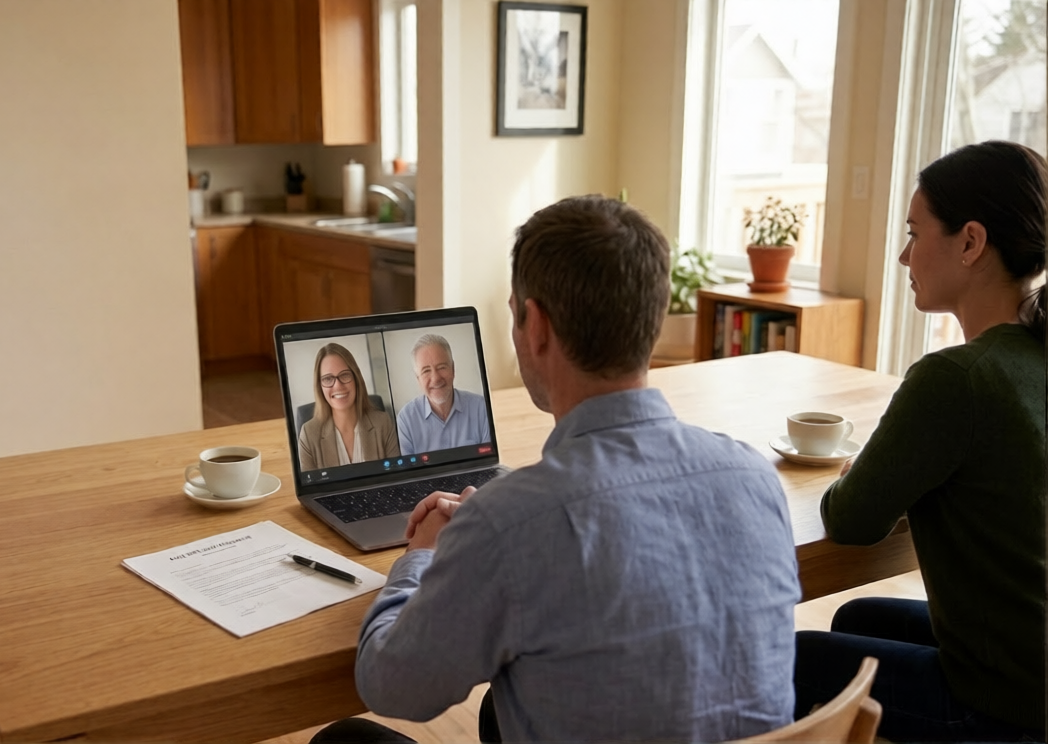
In Alberta, you and your witnesses connect by video in real time, where everyone can see, hear and speak to each other at once. One of those witnesses has to be a lawyer who’s an active member of the profession, and specifically the lawyer who advised you on the document. The second witness is usually someone from that lawyer’s office. Everyone then signs identical copies in wet ink. Not an electronic signature, not a typed name in a box. Actual pen on actual paper. Those signed copies get combined, so your finished will might be three identical copies executed in counterpart that together form one valid document. It looks odd if you’ve only ever seen a will signed the traditional way, but it’s a properly executed will.
Ontario works much the same way, except the required witness can be a lawyer or a paralegal licensed by the Law Society of Ontario. Saskatchewan also requires a lawyer as one of the two witnesses, and the original document travels between the people signing it, with each signature acknowledged over video.
British Columbia is the outlier. For a will, the witnesses can attend electronically and sign in counterpart, and neither of them has to be a lawyer or notary. BC also allows genuinely electronic wills, created, signed and stored digitally. For an enduring power of attorney witnessed remotely, though, the witness does have to be a lawyer or a BC notary public, and the document has to record that the alternative process was used.
One thing worth clearing up, because it stops a lot of people before they start. If you’ve been picturing yourself rounding up two willing witnesses, that was never really your job. A lawyer’s office supplies them, and always has. What you had to supply was everyone’s presence in one place on one afternoon, and that’s the part that’s changed.
What changed is where you sign and how many calendars have to line up. What didn’t change is that a professional is usually still in the room, even when the room is a video call. You’re not signing your will alone at the kitchen table on a Sunday afternoon.
The part nobody legislated
Your lawyer can draft anything you ask for. What your lawyer can’t do is decide who should raise your children, or whether your executor is the right person or just the oldest person, or how to divide things between the daughter who’s driven you to appointments for a decade and the son who lives three provinces away, or what happens to the cabin when one of your kids wants to keep it and the other wants the money.
Those decisions are yours, and they’re the ones that make appointments long, expensive and sometimes unfinished. A lawyer who has to draw your family tree from scratch, ask three times what you own, and then wait while you and your spouse have a conversation you’ve never had, is a lawyer billing you for all of it.
Three appointments instead of one
Bashir booked with a lawyer two weeks after he read that Alberta had made remote signing permanent. He expected one meeting. About twenty minutes in, he was asked who should serve as executor if his brother couldn’t, and he realized he’d never once thought about it. Then came the question about his RRSP, which still named his first wife as beneficiary, and whether that was deliberate. The meeting ended with a list of things for Bashir to go home and figure out. It took two more appointments to get to a signature. The video call had saved him the trouble of finding witnesses. It hadn’t saved him a dollar or his time.
None of what held Bashir up had anything to do with scheduling, and no change in the law was going to sort it out for him.
That’s what The Will Blueprint™ is for. It covers twelve sections of will preparation in plain language with jurisdiction-specific guidance, from your personal and family situation through executor selection, assets, beneficiary designations and how the estate gets divided, plus a special circumstances section for the issues most often missed. It generates a summary organized by section, flags what your lawyer needs to address and in what order, gives you a document checklist for the appointment, and sets out your next steps.
Show up to that video call with it, and the meeting is about your decisions instead of your paperwork.
What you’d want answers to first
Whether you use a tool or a legal pad, these are the questions that make the difference between one appointment and three. Who your executor is, and whether you’ve actually asked them, because naming someone isn’t the same as them agreeing to do it. What you own and roughly what it’s worth, including anything held outside your province. Who gets what, and what happens if a beneficiary dies before you do. Your beneficiary designations on RRSPs, RRIFs, TFSAs and life insurance, which typically pass outside the will entirely and usually win when they contradict it. And anything that makes your situation less than standard: a blended family, a beneficiary who receives provincial disability benefits, a business, property in another country, or a child you’re deliberately leaving out and why.
Those are the things that need to be raised and decided before the appointment rather than discovered at it.
It isn’t only your will
When people talk about estate planning, the will gets all the attention, but it’s rarely the document your family needs first. A power of attorney and a personal directive are what matter while you’re still here and can’t speak for yourself, and in Alberta all three can be signed remotely under the same rules. Ontario’s changes covered powers of attorney as well. BC allows remote witnessing for enduring powers of attorney and representation agreements, with that lawyer or notary requirement attached.
The names differ depending on where you live, and in most of the country these are two separate documents rather than one. On the money side, it’s a continuing power of attorney in Ontario and an enduring power of attorney nearly everywhere else. On the health and personal care side, the same document is a power of attorney for personal care in Ontario, a personal directive in Alberta, Nova Scotia and the Northwest Territories, a health care directive in Manitoba, Saskatchewan, New Brunswick and Prince Edward Island, an advance health care directive in Newfoundland and Labrador, and a representation agreement in British Columbia.
Quebec does it differently again. One document, the protection mandate, covers both your person and your property, and it has to be approved by a court before the person you named can start acting on it.
The scheduling problem was doing us a favour, in a way. It made putting this off seem reasonable. Nobody argues with a calendar, and as long as the appointment couldn’t be booked, the harder questions underneath it didn’t have to be answered.
Those questions don’t come with a deadline, and nobody can answer them for you. They’re also not as big as they feel. An evening at the kitchen table with the person you’d be deciding alongside, a few things written down, and you’re ready to make the call.
The card’s still in the drawer. The excuse isn’t.
Visit our services page to see how we can help.
Watch our video here, or watch on our YouTube Channel:
Prefer a podcast? Listen here!
Please send us your questions or share your comments.
Disclaimer: This content is for general information only and is not legal, financial, medical, or tax advice.