The Digital Side of Estate Planning
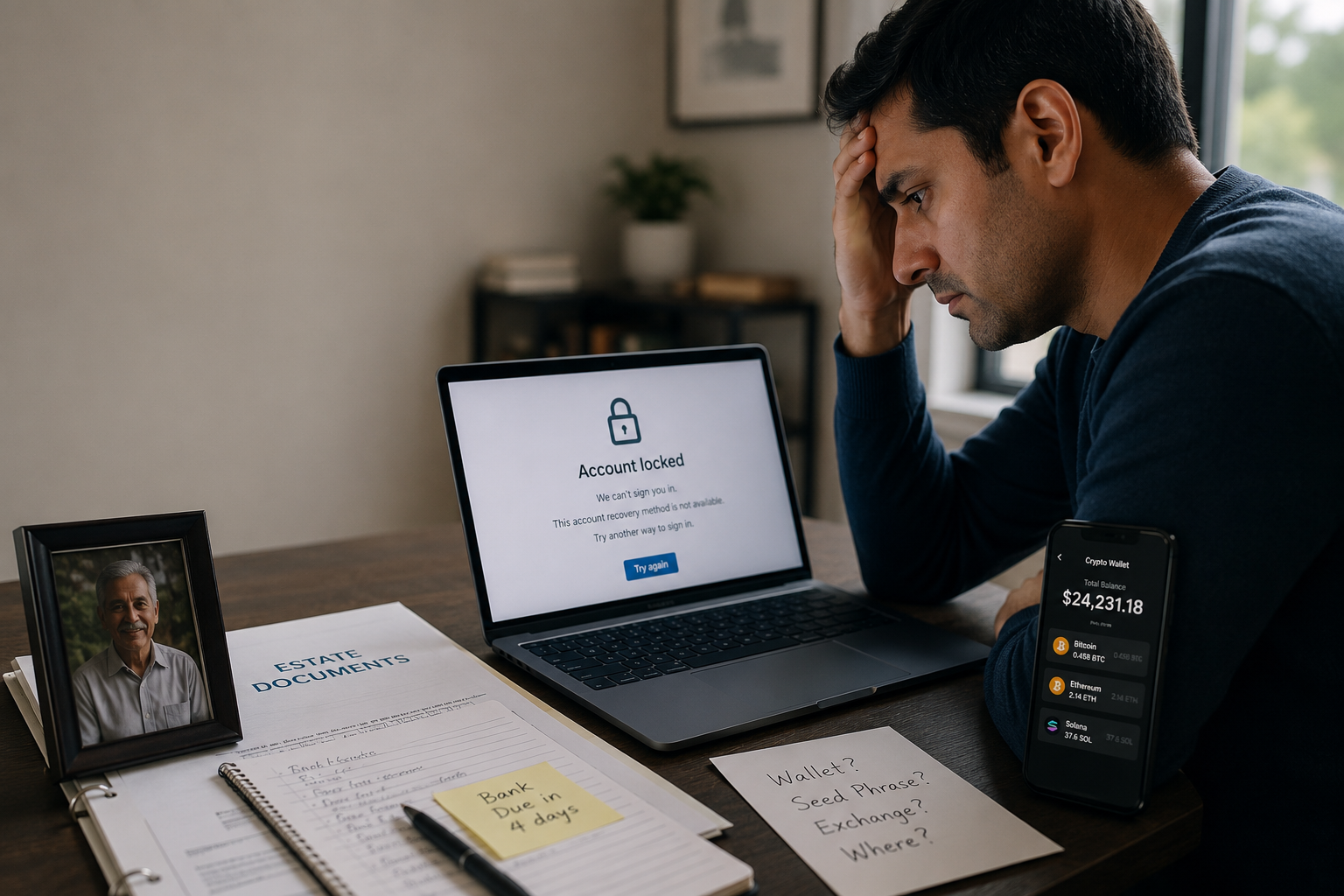
When Arjun Mehta’s father died in the fall, the funeral was the least of his problems. His dad’s line of credit payment was due in four days, and the only way into the bank’s site was a two-factor code sent to an email account Arjun couldn’t open. He later learned his dad had set up a Google Inactive Account Manager years earlier, naming a friend Arjun had never met as the one who’d eventually get access, long after any four-day window would have mattered.
That’s the story most people don’t hear until it happens to them. We plan for the house, the bank accounts, the car. Almost nobody plans for the version of themselves that lives online, and the gap between what people assume happens to their digital accounts and what actually happens can catch even the most prepared families off guard.
The assumption that trips everyone up
Most people picture their executor logging into an account the same way they would: type in a password, see everything, done. In reality, an executor’s authority comes from a grant of probate, and that authority is meant to extend to every asset in the estate, including digital ones. The problem is that privacy law and platform terms of service don’t always agree with that. An executor can have every legal right to an account and still get turned away.
Canada doesn’t have a national framework for this the way some other countries do. What exists instead is a patchwork: a handful of provinces with legislation, a few court decisions that are starting to push back on uncooperative platforms, and a lot of families left to figure it out account by account.
Where executors get stuck
Cryptocurrency is the sharpest example of this problem, because access depends entirely on how the asset was held. If it sat on an exchange, an executor can generally file a death claim with a death certificate and probate documents, much like closing a brokerage account. If it was self-custodied in a wallet, the private keys are the only way in, and if those keys are not accessible, there’s no customer service line to call to recover them.
her partner died unexpectedly, and she knew he’d been putting money into Bitcoin for a few years. She just didn’t know where. She found a hardware wallet in a drawer, but no password, no seed phrase, nothing written down anywhere. Months later, she’s still not certain how much was there or whether it’s gone for good.
Crypto investors got a national-scale lesson in this when Gerald Cotten, founder of what was once Canada’s largest cryptocurrency exchange, QuadrigaCX, died suddenly in 2018. He was the only person who knew the passwords to the exchange’s cold wallets. According to his widow’s affidavit filed in the bankruptcy proceedings, roughly $250 million CAD in customer crypto was left locked away, unreachable by anyone else. It’s an extreme case, but the underlying problem, one person holding the only key, plays out in ordinary estates every day.
Email, cloud storage, and social media hinge on whatever tools the platform happens to offer, and this is where Arjun’s story matters most. Google has an Inactive Account Manager. Apple has a Digital Legacy program. Facebook has a Legacy Contact. Under the model legislation several provinces are working from, whichever instruction came most recently takes priority. So someone who names a digital executor in their will, then years later sets up an Inactive Account Manager and forgets about it, has narrowed what that executor can do.
Subscriptions and online banking are the least dramatic and the most time-consuming. Executors typically need a death certificate and proof of their authority just to close an account or access a balance, and with dozens of small recurring accounts, the paperwork adds up fast even when nothing valuable is at stake.
That paperwork assumes the executor already knows what they’re looking for. Often they don’t. Without a list, an executor is left piecing things together from paper statements, old emails, and whatever recurring charges show up on a bank statement after the fact. A streaming subscription might keep billing a credit card that’s still active without anyone noticing. A second bank account at a smaller institution might never show up at all, because there’s no central registry that tells an executor where someone banked. Account numbers, in particular, are rarely written down anywhere, which means even a cooperative bank often needs the executor to prove the account exists before they’ll discuss it, not the other way around.
How this shifts by province
Saskatchewan, Prince Edward Island, and New Brunswick have all passed legislation that gives an appointed executor or attorney a clear right to deal with digital assets, similar to how they’d handle any other property. Most other provinces still have nothing specific on the books, which means the default is whatever the platform’s own terms of service happen to say.
Alberta hasn’t passed anything yet, but movement is happening on two fronts. The Alberta Law Reform Institute recommended in 2024 that the province adopt this kind of legislation, confirming an executor’s existing authority already extends to digital accounts. Then this spring, in a case called Wada Estate, the Court of King’s Bench affirmed that tech companies are bound by a grant of administration just like anyone else, and shouldn’t be allowed to slow down an estate simply because the asset happens to be digital. The law isn’t on the books yet, but the courts are already moving in that direction.
she was named executor for her sister’s estate and assumed the grant of probate would open every door. It opened most of them. One overseas subscription service simply refused to respond to anything, probate included, and there was no local court to compel it. She eventually let it go. Some things stay out of reach, and knowing that ahead of time would have saved her weeks of frustration.
British Columbia has no specific framework either. Its estate legislation predates cryptocurrency and cloud computing entirely, so digital assets get handled under general property law, with a grant of probate theoretically covering them even though platforms don’t always see it that way.
What makes a difference
Legal authority usually isn’t the obstacle anymore, especially with courts starting to push back the way they did in Wada Estate. What trips executors up is not knowing an account exists in the first place.
A few things consistently make the difference:
- A current, maintained list of accounts and where they’re held, updated as things change, not written once and forgotten.
- For crypto specifically, the location of wallets and keys matters more than anything written in the will itself.
- Passwords never belong in the will. Wills become public documents through probate, so credentials need a separate, secure home.
- Platform tools like an Inactive Account Manager or Legacy Contact should be set up to match what the will says.
This is what In Plain Sight™ was built for: one place to record every account, every asset, every digital detail your executor will need, so none of it depends on someone finding a hardware wallet in a drawer or guessing at a password. It’s part of the full planning toolkit.
Getting it all in one place
Once you’ve built your In Plain Sight record, it exports as both a PDF and a downloadable file, so however you choose to store it, the record itself travels with you.
Where you keep that finished document matters too. A fireproof home safe works. A safety deposit box works. Some people also choose to store the completed file in an encrypted online vault, like the one offered by InheritIQ, so it’s accessible the moment it’s needed instead of locked away somewhere only they know about.
Arjun eventually got into his dad’s accounts, days later than he needed to. His dad had done almost everything right. He just hadn’t connected the will to the accounts themselves, and that is what catches most families off guard.
Visit our services page to see how we can help.
Watch our video here, or watch on our YouTube Channel:
Prefer a podcast? Listen here!
Please send us your questions or share your comments.
Disclaimer: This content is for general information only and is not legal, financial, medical, or tax advice.